Kids Shoe Size Chart
Type your child's foot length in cm or inches and see the size on two published brand charts side by side, from baby 1C to youth 7Y. Nothing is uploaded.
Recent
Your last 10 settings, saved only in this browser. Nothing is uploaded.
This kids shoe size chart finds a shoe size from a foot length. Type the length into the “Foot length” box, choose “cm” or “inches” under “Unit”, and the tool shows the matching size on two published charts side by side: Nike’s kids’ footwear size charts and Stride Rite’s Kids’ Shoe Sizing Help chart.
It is a chart lookup, not a formula, so every number comes from a row printed on one of those pages. The entries run from 1C, at about 9 cm, to 7Y, at about 25 cm, covering babies, toddlers, little kids and big kids. The tool runs in your browser, is free, needs no sign-up and uploads nothing. Nike and Stride Rite are named only as the two sources; this site is not affiliated with or endorsed by either company.
How to use the kids shoe size chart
- Measure one foot in centimetres or inches. If the two feet differ, use the longer one. The section on how to measure kids shoe size below describes two ways to do it.
- Type the length into the “Foot length” box. A decimal such as 5.94 or a mixed fraction such as 5 15/16 both work.
- Set “Unit” to cm or inches to match your measurement.
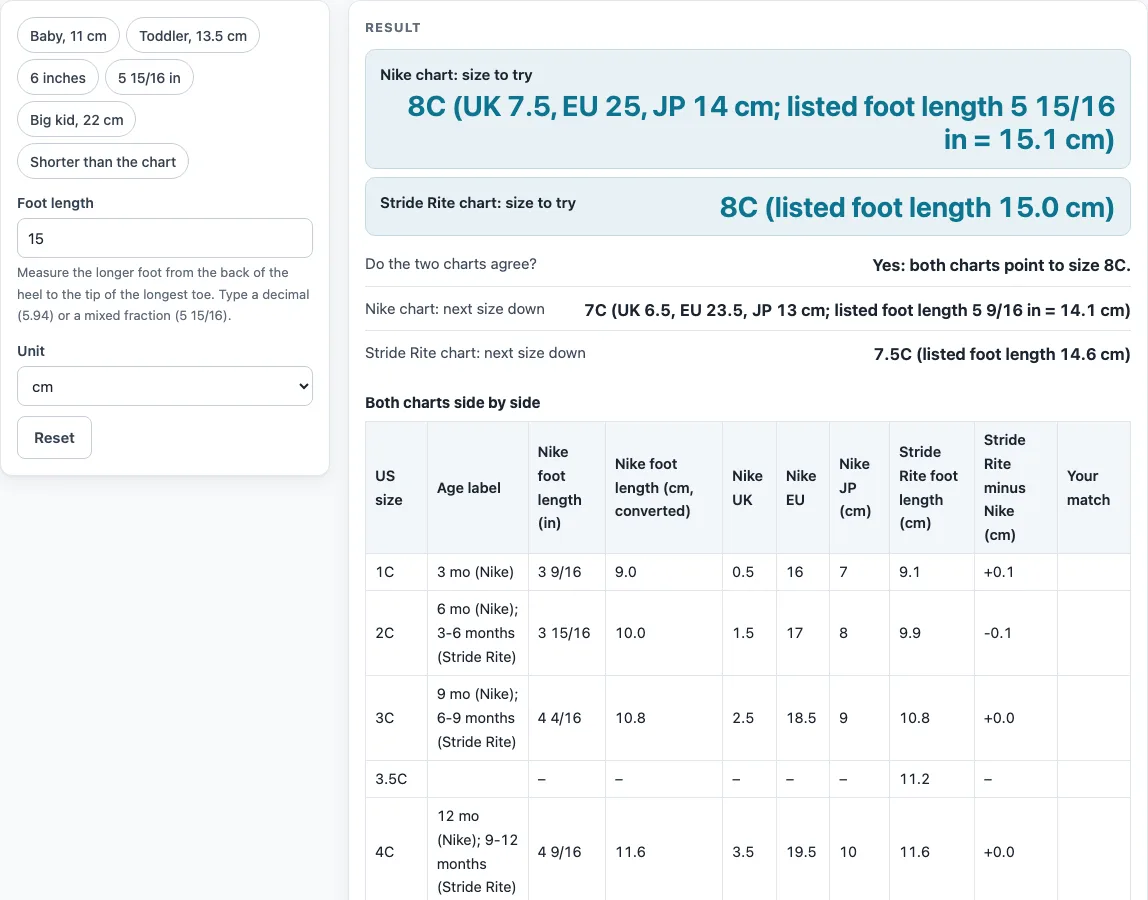
- Read “Nike chart: size to try” and “Stride Rite chart: size to try”. Each shows a US size and the foot length that chart lists for it.
- Check “Do the two charts agree?” If they do not, both sizes stay on the page so you can compare them.
- Look at “Nike chart: next size down” and “Stride Rite chart: next size down” to compare the smaller option.
- Read “Age label on the chart” when one is shown.
- Scroll to “Both charts side by side” and find your row in the “Your match” column.
To try an example first, click one of the six buttons: “Baby, 11 cm”, “Toddler, 13.5 cm”, “6 inches”, “5 15/16 in”, “Big kid, 22 cm” or “Shorter than the chart”. “Reset” clears the form. “Copy result” copies the answer, and “Copy link” copies a link that stores your size and unit. Use “Print” to print the result, or “Print foot ruler (actual size)” for a ruler page. Print the ruler at 100 %, not fit to page, and check that its 10 cm bar measures 10 cm.
How to measure kids shoe size
Measure from the heel to the longest point of the toes on both feet, and use the longer foot, because one foot is often longer. If you have no printer, trace the foot on blank paper placed on the floor against a wall, with the child standing and the heel against the wall, then measure the tracing with a tape measure. Stride Rite’s page says to mark the first visible line past the big toe and to measure every two months, because feet can grow half a size every two to four months. Many fitters also suggest measuring late in the day, when feet are at their largest; neither chart page says this, so treat it as general advice.
Sizes vary by brand. These are two companies’ charts, not a standard, so the size on another maker’s box can differ from what you see here. Use the chart of the shoe you are buying when it has one.
Shoe sizes for kids
The tool picks the first listed size whose foot length is at least your measurement. Both sources say to take the larger size when a child falls between sizes, and the tool follows the same rule. A length within 0.2 mm of a printed length counts as that length, which only absorbs rounding when inches are converted to centimetres. The two charts are never averaged, and no formula is used.
Both charts list kids shoe sizes as a printed foot length for each size, so every answer comes from a row. Nike’s chart has three tables. Babies and Toddlers covers 1C to 10C, from 3 9/16 in to 6 9/16 in, so it is the part to read for a baby shoe size chart, an infant shoe size chart or a toddler shoe size chart. Little Kids runs from 8C to 3Y, and Big Kids runs from 1Y to 7Y, up to 9 11/16 in, which is the big kid shoe size chart on Nike’s page. For 1C to 7C, Nike also prints an age in months: 3, 6, 9, 12, 18, 24 and 36.
Stride Rite’s chart is in centimetres only, with US sizes 1 to 10 (9.1 to 16.7 cm), 10.5 to 13.5 (17.1 to 19.6 cm) and youth sizes 1 to 7 (20.1 to 25.1 cm). The page prints no letters, so the tool adds C up to 13.5 and Y for the youth sizes that follow.
The two charts agree closely for the smallest sizes; at 3C, both list 10.8 cm. They drift apart for big kids. Size 7Y is 9 11/16 in, or 24.6 cm, on Nike but 25.1 cm on Stride Rite. Stride Rite also lists half sizes from 3.5, which Nike does not list below 10.5C. When the matched rows are 0.3 cm or more apart, the tool shows a warning, and both results stay on the page.
The chart runs from 1C, about 9 cm, to 7Y, about 25 cm. A foot shorter than the first row shows that row with a warning. A longer foot shows no size, because neither page gives an adult size for that length, and the tool does not convert to adult or women’s sizes. The accepted foot length is 5 to 40 cm.
Sources (checked 17 October 2026): nike.com · striderite.com
Worked examples
| Input | Result |
|---|---|
| Foot length 15 cm | Nike 8C, Stride Rite 8C |
| Foot length 6 in | Nike 9C, Stride Rite 8.5C |
| Foot length 5 15/16 in | Nike 8C, Stride Rite 8.5C |
| Foot length 12.2 cm | Nike 5C, Stride Rite 5C |
| Foot length 22 cm | Nike 3.5Y, Stride Rite 3.5Y |
| Foot length 8 cm | Nike 1C, Stride Rite 1C |
Calculated by the tool above; open it with the same values to see each step.
Frequently asked questions
What is a kids shoe size chart for?
A kids shoe size chart matches a foot length to a shoe size. This tool checks two published charts, Nike’s and Stride Rite’s, and shows the size each one lists for your measurement.
Does the tool use age to pick a size?
No. It uses only foot length. Stride Rite’s page says shoe size does not match age except for babies, and the age labels are shown in “Age label on the chart” for reference only.
Why do the two charts sometimes give different sizes?
The charts list slightly different foot lengths, especially for big kids. Size 7Y is 24.6 cm on Nike and 25.1 cm on Stride Rite. When the matched rows are 0.3 cm or more apart, the tool shows a warning.
What happens if my foot is shorter than the chart?
The tool shows the first row with a warning. The chart starts at 1C, which is about 9 cm, so a very small foot will still be shown against that row.
What happens if my foot is longer than the chart?
No size is shown. Neither page gives an adult size for that length, and the tool does not convert to adult or women’s sizes, so you will need another source for a larger shoe.
How do I measure kids shoe size at home?
Trace the foot on blank paper against a wall, then measure the tracing with a tape measure. You can also use “Print foot ruler (actual size)”, which prints a plain ruler page; print it at 100 % and check the 10 cm bar with a ruler before you rely on it.
- eBay fee calculator: if you resell kids’ shoes and clothes on eBay, see what the sale leaves you after fees.
- Mercari fee calculator: the same check for a Mercari sale.
- Poshmark fee calculator: the same check for a Poshmark sale, with the rates read from Poshmark’s own page.
- Marketplace fee comparison: compare what several marketplaces keep from one sale before you pick where to list.
- Selling price calculator: start from the profit you want and work back to the listing price.
- Label sheet layout: print your own text on a sheet of labels, for example size labels for a stock room.
- Children’s product certificate generator: lay out a certificate sheet if you import or make children’s products; you sign it, we do not certify anything.