eBay Profit Calculator
Enter what you sell for and what it costs you to see profit after eBay fees, the margin and the break-even price.
Recent
Your last 10 settings, saved only in this browser. Nothing is uploaded.
How to use the eBay Profit Calculator
- Pick a preset if one matches your sale: “$40 toy set”, “With a 5% ad rate”, “3% returns, 2% ad”, “$18, free shipping” or “Thin margin, $14.99”. You can change any value afterwards.
- Enter “Item price ($)”, the price the buyer pays for the item without shipping.
- Enter “Shipping you charge the buyer ($)”. Use 0 for free shipping.
- Enter “Your actual shipping cost ($)”, what you pay to post the item.
- Enter “Item cost ($)”, what the item cost you.
- Enter “Other costs per order ($)”, such as packaging, as a single amount. Leave it at 0 if you have none.
- Enter “Ad rate (%)” if you use promoted listings. Leave it at 0 otherwise.
- Enter “Returns allowance (% of sale)”, the share of the sale you set aside for returns. Leave it at 0 if you do not plan for returns.
- Open “More options” to choose the category. “Most categories” includes toys. If you have an eBay Store, pick the Store category and type your rate in “Store rate override (%)”. The same section holds the international fee, sales tax, number of identical orders, performance surcharge, insertion fee and per-order fee override.
- Read “Profit per order” and “Break-even item price”, then check any warning.
Presets fill in the values for a common case, so you can compare a sale with and without an ad rate or returns allowance in a few clicks.
How does the eBay profit calculator work out profit?
The eBay profit calculator takes your item price and shipping charged, works out the fees, then subtracts your costs. The total sale amount that fees are based on includes shipping and sales tax, as eBay’s page describes it.
The final value fee is 13.6% of the total sale amount up to $7,500, and 2.35% of any amount above that, for the “Most categories” rate. Other categories use the rates the calculator lists, such as 15.3% for Books & Magazines, Movies & TV and Music. A per-order fee is added on top: $0.30 for totals up to $10.00, and $0.40 above that. Any optional fees you choose are added to these.
Profit is then calculated as item price plus shipping charged, minus total fees, item cost, your shipping cost, other costs and the returns allowance. The ad fee is the ad rate multiplied by the item price plus shipping charged. eBay’s rules for the ad fee base were not read for this tool, so a warning says so. The returns allowance is a percentage of the same base. It is a cost you set yourself and is not an eBay fee.
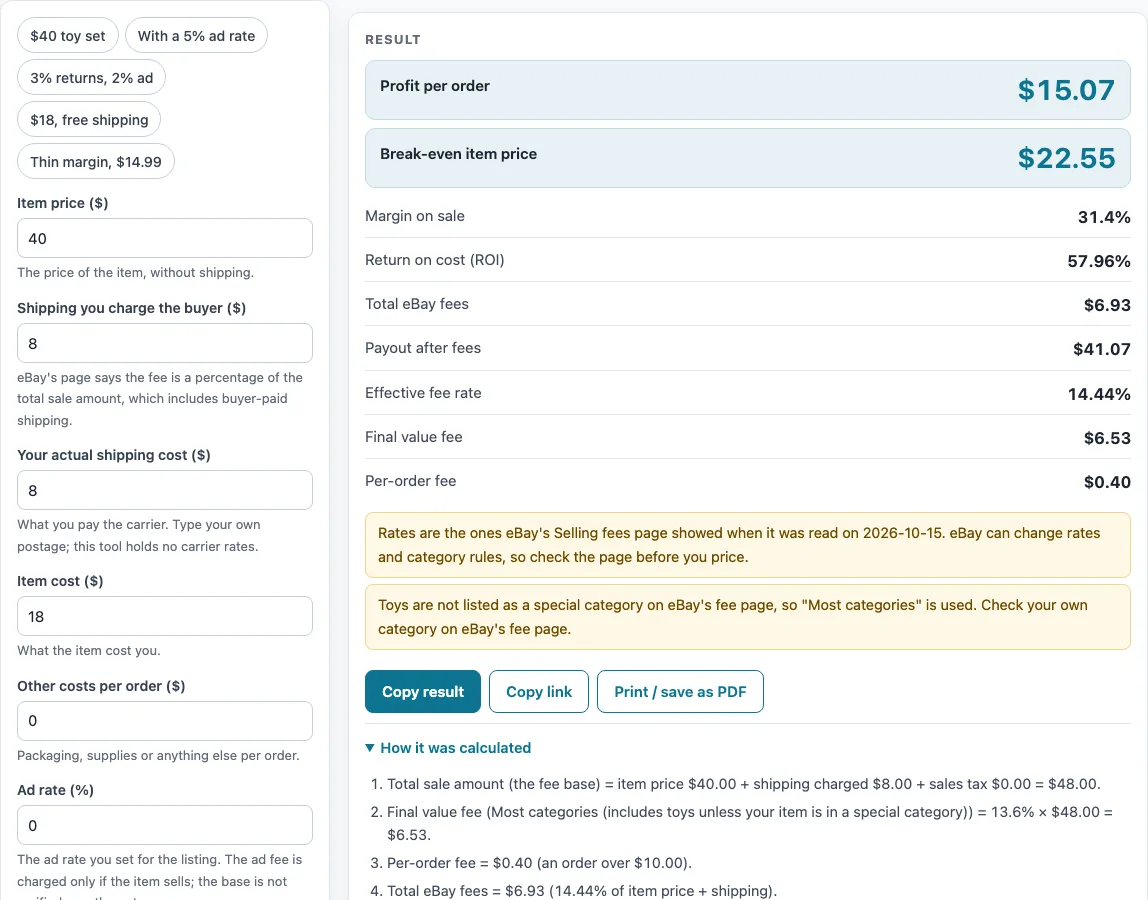
Using the default values, the total sale amount is $48.00. The fees are $6.93, so the payout is $41.07 and profit is $15.07, which is a margin of 31.4%.
Which optional fees can be added?
Under “More options” you can add the international fee of 1.65% of the total sale amount, which the page says is not charged when a US seller offers eBay International Shipping on eligible listings. You can also add the $0.35 insertion fee, which applies only after the free listings for the month, and a performance surcharge. The page words the surcharge as an extra 6% on the final value fee, 7% after four or more months, and 5% or 6% for “item not as described” cases. The calculator applies the percentage to the total sale amount, which is not confirmed, so compare it with your own fee statement.
What do break-even item price, margin and ROI mean?
The break-even item price is the lowest item price, to the cent, at which profit is zero or more, with the shipping charge you entered kept the same. With the defaults, the figure is $22.55. At that price the fee is $4.15 plus $0.40, and profit is $0.00.
Margin is profit divided by the item price plus shipping charged. ROI is profit divided by the item cost, shipping cost, other costs and returns. A 5% ad rate on the defaults adds $2.40, which is 5% of $48.00, and lowers profit to $12.67.
Sources (checked 15 October 2026): ebay.com
Worked examples
| Input | Result |
|---|---|
| $40.00 item + $8.00 shipping, Most categories (includes toys unless your item is in a special category) | profit $15.07, margin 31.4%, break-even price $22.55 |
| $40.00 item + $8.00 shipping, Most categories (includes toys unless your item is in a special category) | profit $12.67, margin 26.4%, break-even price $24.43 |
| $25.00 item + $5.00 shipping, Most categories (includes toys unless your item is in a special category) | profit $8.12, margin 27.07%, break-even price $15.27 |
| $18.00 item + $0.00 shipping, Most categories (includes toys unless your item is in a special category) | profit $1.65, margin 9.17%, break-even price $16.09 |
Calculated by the tool above; open it with the same values to see each step.
Frequently asked questions
Is this eBay profit calculator free?
Yes. It is free to use and needs no sign-up. It runs in your browser.
Does the calculator upload the numbers I enter?
No. Everything runs in your browser and nothing is uploaded.
Why does a warning appear?
A warning appears when the item price is below the break-even item price, and when the sale loses money. It also appears when the ad fee base is not confirmed, because eBay’s rules for that base were not read.
Are the fees the same as what eBay charges me?
The results are calculated from your inputs and the rates published on eBay’s Selling fees page, as read on 2026-10-15. eBay can change those rates, and your own fee statement from eBay is the final record.
Does quantity change profit per order?
No. Profit per order is for one sale. The number of identical orders you enter under “More options” only changes the “Total profit, all orders” figure.
Why does the trading cards rate differ?
The page fetch showed 13.25% for trading cards, while a separate search-result snippet of a promotional page showed 12.35% for Basic+ Stores. The calculator uses 13.25%, the non-Store rate. If you have an eBay Store, pick the Store category and type its rate, and check eBay’s own page for it.
Related tools
- Marketplace Fee and Profit Calculators: use it to browse every fee and profit calculator on this site.
- eBay Fee Calculator: use it when you only need the fees for a sale, with the same fee maths as this page.
- eBay Price Calculator: use it when you want to work out the item price you need to reach a target.
- eBay Shipping Calculator: use it to compare charging the buyer for shipping with free shipping.
- Marketplace Fee Calculator: use it to see the same sale on several marketplaces side by side.
- Amazon Referral Fee Calculator: use it when you sell on Amazon and need its referral fee.
- Amazon FBA Profit Calculator: use it when you sell on Amazon through fulfillment and want the profit.
- Mercari Fee Calculator: use it when your sale is on Mercari.
- Depop Fee Calculator: use it when your sale is on Depop.