CPSIA Testing Checklist
Print a worksheet of the rules CPSC's own list names, with blank columns where you and your lab note what applies, report numbers and dates. It decides nothing and tests nothing.
Recent
Your last 10 settings, saved only in this browser. Nothing is uploaded.
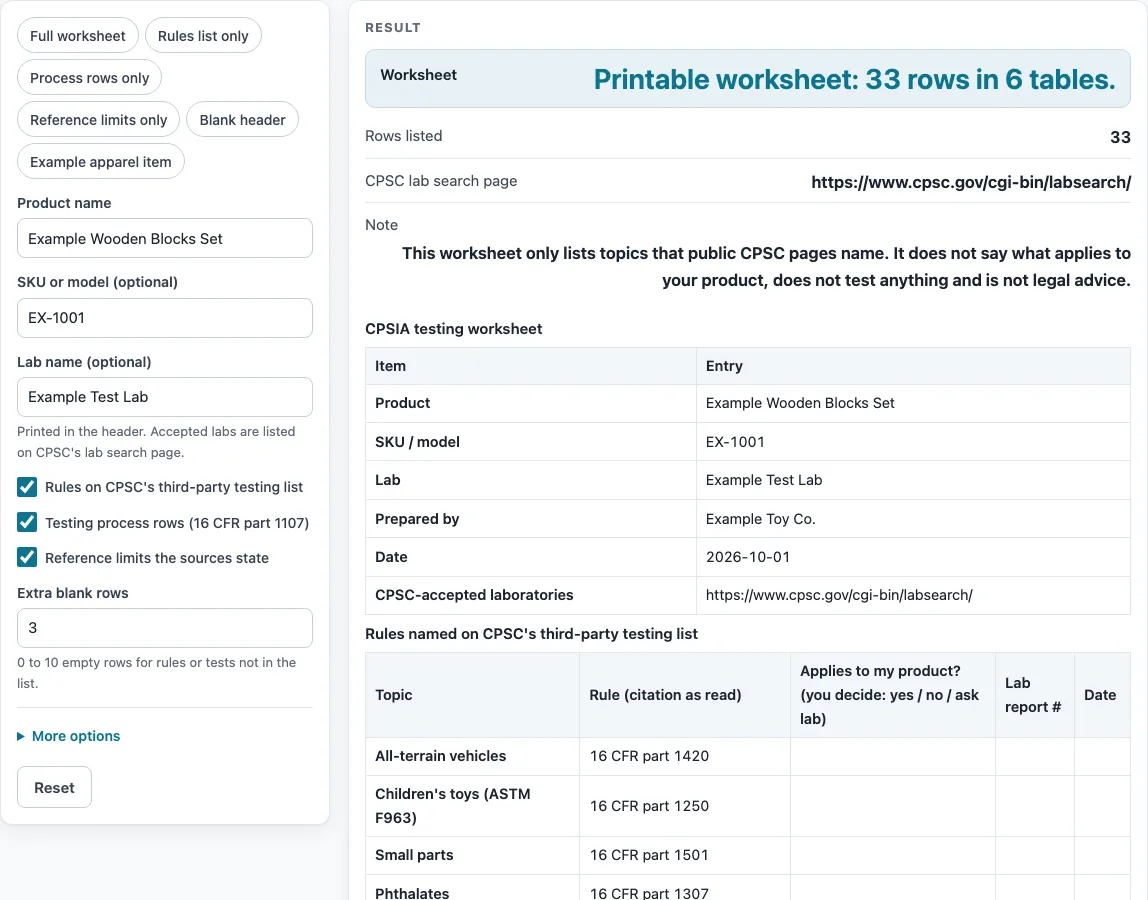
How to use the CPSIA Testing Checklist
- Type your “Product name”. A blank name gives a warning and prints a blank line.
- If you want, enter “SKU or model (optional)” and “Lab name (optional)”.
- Choose a preset: “Full worksheet”, “Rules list only”, “Process rows only”, “Reference limits only”, “Blank header”, or “Example apparel item” (Example Cotton Pajamas, EX-2001, 5 extra rows).
- Use the boxes “Rules on CPSC’s third-party testing list”, “Testing process rows (16 CFR part 1107)” and “Reference limits the sources state” to choose which sections appear. You need at least one section or one extra row, or the page shows an error.
- Set “Extra blank rows” from 0 to 10. Values above 10 are cut to 10 with a warning.
- Under More options, fill in “Prepared by (optional)” and “Date (optional)”.
- Check the result panel for “Rows listed” and the CPSC lab search URL. With all sections and 3 extra rows, the sheet has 33 rows in 6 tables.
- On the printed or downloaded sheet, fill in the “Applies to my product? (you decide: yes / no / ask lab)” column by hand, plus “Lab report #” and “Date”.
The sheet leaves the “Applies to my product?” column empty, so every decision stays with you. Use “Download as CSV (opens in Excel)” to save all tables, or “Print / save as PDF” to print them. Sample entries such as Example Wooden Blocks Set and Example Test Lab are fictitious.
What rules does the CPSIA testing list cover?
The rules table has 22 rows, one for each rule named on CPSC’s third-party testing list page, with its citation as read. The rows follow the page’s order, from All-terrain vehicles (16 CFR part 1420) to Bicycle helmets (16 CFR part 1203). Examples include Children’s toys (ASTM F963) - 16 CFR part 1250, Small parts - 16 CFR part 1501, Phthalates - 16 CFR part 1307, and Magnets - 16 CFR part 1262.
The sheet does not filter rows by product type. The list page names rules by citation and, in the text read, does not tie them to product types. Your job is to mark each row yes, no, or ask lab. The citations came from a summarized fetch of the page and were not checked word for word, so compare them with the live page.
Who can act as the lab for cpsia testing?
Under 16 CFR part 1107, the lab must have accreditation that CPSC accepts, and its scope must cover the required tests (1107.2). Samples must be sufficient to give a high degree of assurance (1107.20(a)). Periodic testing by a third-party lab is required at least once a year unless otherwise provided (1107.21(a),(b)).
A material change needs a third-party retest and a new certificate (1107.23(a)). The importer, manufacturer or private labeler issues the certificate based on test reports from a CPSC-accepted laboratory. Use the “Lab report #” and “Date” columns to record each report, and use the CPSC lab search link on the result panel to find accepted labs.
What limits do the reference rows show?
The reference table lists four statements from the sources. It is a record of what they say, not a check of your product. Total lead content is stated as 100 parts per million (15 U.S.C. 1278a). Lead in paint above 0.009 percent (90 ppm) counts as lead-containing paint since Aug 14, 2009 (16 CFR 1303.1(a)).
The phthalate row states no more than 0.1 percent of each listed phthalate (1307.3). The small-part ban for toys for children under 3 is in 1500.18(a)(9) and part 1501. Read the rule text on the eCFR before you rely on any of these figures.
Sources (checked 16 October 2026): cpsc.gov · ecfr.gov · cpsc.gov · ecfr.gov · ecfr.gov
Worked examples
| Input | Result |
|---|---|
| Product "Example Wooden Blocks Set" | 33 rows in 6 tables |
| Product "Example Cotton Pajamas" | 22 rows in 3 tables |
| Product "Example Wooden Blocks Set" | 7 rows in 4 tables |
| Product "__________" | 33 rows in 6 tables |
Calculated by the tool above; open it with the same values to see each step.
Frequently asked questions
Does this tool test my product or issue a certificate?
No. The site does not test products or issue certificates. The importer, manufacturer or private labeler issues the certificate based on test reports from a CPSC-accepted laboratory.
Why is the “Applies to my product?” column empty?
The sheet leaves that column blank on purpose. Enter yes, no, or ask lab for each row once you have reviewed the rule text.
Does the sheet filter rules for my product type?
No. It shows one list of 22 rows, because CPSC’s list page names rules by citation and does not tie them to product types in the text read.
How current is the rules list?
The sheet says the list was complete as of Dec 5, 2024, per CPSC’s page. Check the live page and ask your lab before you rely on it.
Is my data uploaded anywhere?
No. Everything runs in your browser, and nothing is uploaded.
Where do I find a CPSC-accepted lab?
The result panel shows the URL of CPSC’s lab search page, https://www.cpsc.gov/cgi-bin/labsearch/. The worksheet header prints the same line, “CPSC-accepted laboratories”.
What are the extra blank rows for?
They add 0 to 10 empty rows for rules or tests that are not in the list. Values above 10 are cut to 10 with a warning.
Related tools
- Children’s Product Certificates and Testing Paperwork: use when you want the overview of the certificate and testing tools on this site.
- ASTM F963 Checklist: use when you want to list the F963 topics for a toy product file.
- Age Grading Worksheet for Toys: use when you want to record age notes alongside your testing notes.
- Children’s Product Certificate Generator: use when your lab reports are in hand and you want to lay out a children’s product certificate sheet.
- General Certificate of Conformity Generator: use when you want to lay out a general certificate of conformity for a product that is not a children’s product.
- CPSIA Tracking Label Generator: use when you want to lay out tracking label text for a product and its packaging.