Child Height Predictor
Enter the father's and mother's heights and choose girl or boy. You get the mid-parental target height with the MSD Manuals and AAP ranges. Nothing is uploaded.
Recent
Your last 10 settings, saved only in this browser. Nothing is uploaded.
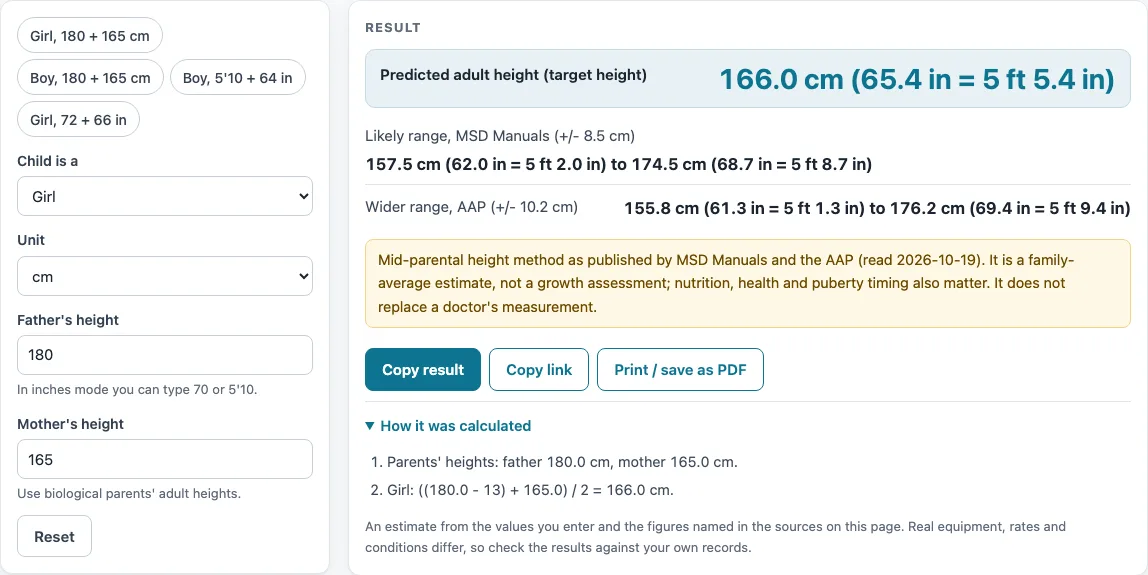
How to use the Child Height Predictor
- Set “Child is a” to “Girl” or “Boy”.
- Set “Unit” to “cm” or “inches (or feet and inches)”.
- Type the “Father’s height”. In inches mode you can type 70 or 5'10.
- Type the “Mother’s height” in the same unit.
- Check the input limits. Each parent’s height must be between 120 and 230 cm, or an error appears. In inches mode the limits are the same heights, converted.
- Read “Predicted adult height (target height)”. It shows the height in cm, in inches and in feet and inches, so you can use whichever you prefer.
- Compare the two ranges: “Likely range, MSD Manuals (+/- 8.5 cm)” and “Wider range, AAP (+/- 10.2 cm)”.
- If the page warns that the parents’ heights differ by more than 30 cm, the estimate may fit the family less well.
- Open “How it was calculated” under the result to see the calculation.
- Use the heights of the child’s biological parents as adults, because the method works from the family average.
To try a common case, click one of the presets: “Girl, 180 + 165 cm”, “Boy, 180 + 165 cm”, “Boy, 5'10 + 64 in”, or “Girl, 72 + 66 in”. Use “Reset” to clear the form. “Copy result”, “Copy link” and “Print / save as PDF” are also available on this page.
How accurate is the mid-parental height formula?
The mid-parental height formula, also called the target height method, predicts adult height from the parents’ heights alone. It gives a family-average estimate: where a child’s adult height would sit if they grew in line with the average of their parents. It does not measure growth, so the range around the number matters as much as the number.
The two published sources differ on that spread. MSD Manuals gives a likely adult height of 8.5 cm (3.35 in) either side of the target height. The AAP page uses one standard deviation of 5.1 cm, which many clinicians round to 5, and gives a wider range of plus or minus 10.2 cm (4 inches in its inch version). The tool shows both ranges rather than merging them, so you can see how much the answer depends on the method. Nutrition, health and puberty timing also affect final height, so a child can end up outside either range.
How tall will my daughter be, and how tall will my son be?
Both answers come from the same two parent heights, with one adjustment for sex. The MSD Manuals page gives 13 cm (5.12 in) as the average difference in height between women and men. The AAP page gives the same difference as 5 inches.
For a girl, subtract 13 cm from the father’s height, add the mother’s height, and divide by two:
Girl: ((father’s height - 13 cm) + mother’s height) / 2
For a boy, add 13 cm to the mother’s height, add the father’s height, and divide by two:
Boy: ((mother’s height + 13 cm) + father’s height) / 2
So for the same parents, a boy’s target height is always 13 cm above a girl’s.
Worked example: father 180 cm, mother 165 cm, girl. ((180 - 13) + 165) / 2 = 166 cm, which is 65.4 in or 5 ft 5.4 in. The MSD range is 157.5 to 174.5 cm, and the AAP range is 155.8 to 176.2 cm. For a boy with the same parents: ((165 + 13) + 180) / 2 = 179 cm.
Worked examples
| Input | Result |
|---|---|
| Girl, father 180, mother 165 (cm) | 166.0 cm |
| Boy, father 180, mother 165 (cm) | 179.0 cm |
| Boy, father 5'10, mother 64 (in) | 176.7 cm |
| Girl, father 72, mother 66 (in) | 168.8 cm |
Calculated by the tool above; open it with the same values to see each step.
Frequently asked questions
Does the tool use my child’s current height or age?
No. It uses only the father’s and mother’s heights. It does not use the child’s current height, age, weight or growth charts, and it does not give a percentile.
Why do the two ranges look different?
The two sources use different methods. MSD Manuals uses 8.5 cm either side of the target height, while the AAP page uses a standard deviation of 5.1 cm and a range of plus or minus 10.2 cm. The page shows both so you can compare them.
What happens if the parents’ heights are very different?
If the parents’ heights differ by more than 30 cm, the page warns that the estimate may fit the family less well. The result still appears, so treat it with more caution.
Can I enter heights in feet and inches?
Yes. Set “Unit” to “inches (or feet and inches)”, then type a height such as 70 or 5'10 for each parent. Each height must still be between 120 and 230 cm once converted.
Can this replace a doctor’s measurement?
No. The page is a family-average estimate, not a growth assessment, and it does not replace a doctor’s measurement. Nutrition, health and puberty timing also affect how a child grows.
- Kids Shoe Size Chart — Type your child’s foot length in cm or inches and see the size on two published brand charts side by side, from baby 1C to youth 7Y
- eBay Profit Calculator — Enter what you sell for and what it costs you to see profit after eBay fees, the margin and the break-even price
- Selling Price Calculator — Work backwards from the profit you want to the price to list, with fees included
- Marketplace Fee Comparison — Compare what several selling platforms take from the same sale