ASTM F963 Checklist
See what 16 CFR part 1250 says about ASTM F963 and print a worksheet of CPSC's 45 topic headings with columns for your notes and lab report numbers. The standard itself is sold by ASTM and is not on this page.
Recent
Your last 10 settings, saved only in this browser. Nothing is uploaded.
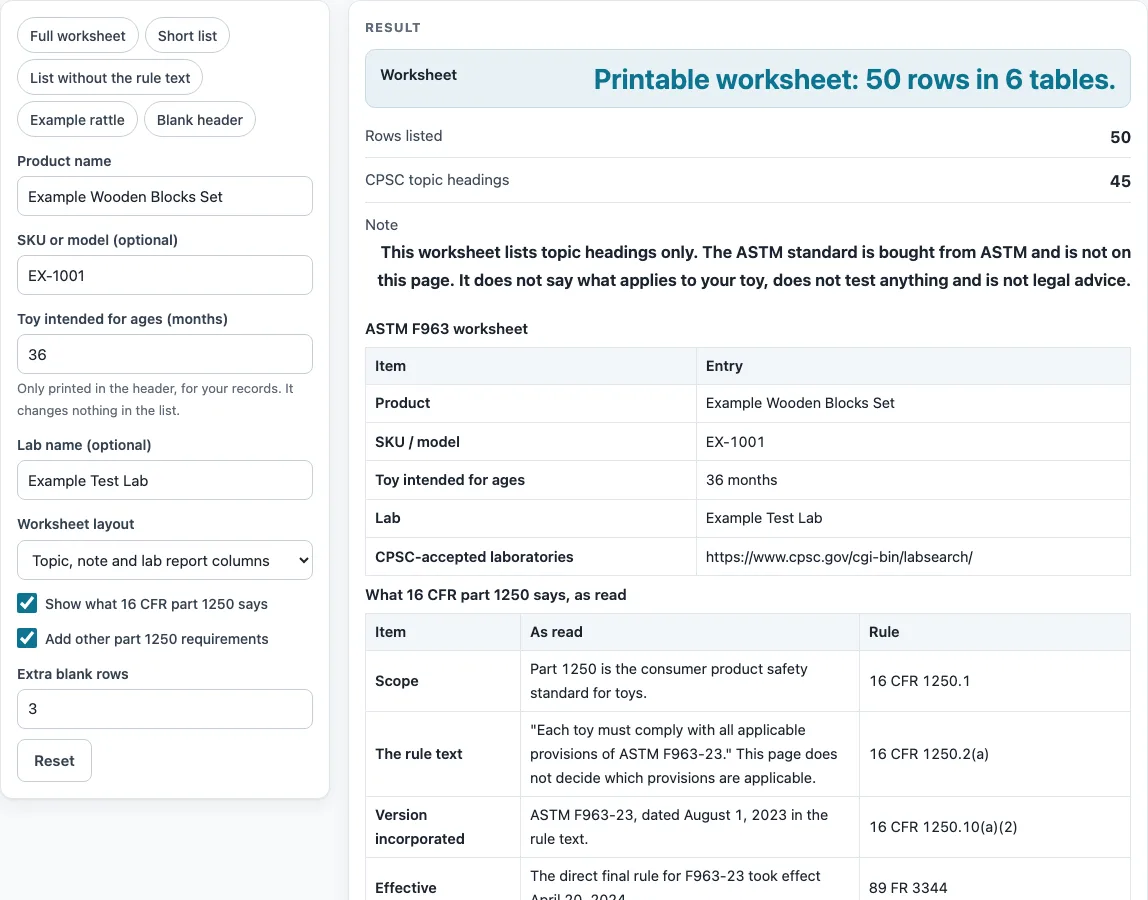
How to use the ASTM F963 checklist
- Pick a preset if one fits: “Full worksheet”, “Short list”, “List without the rule text”, “Example rattle” or “Blank header”.
- Type your “Product name”. A blank product name gives a warning.
- Type a “SKU or model (optional)” if you use one.
- Enter “Toy intended for ages (months)” as a whole number of months, 0 or more. It prints in the header only, for example “36 months”. Text or a negative number is an error.
- Type a “Lab name (optional)” if you have one.
- Choose a “Worksheet layout”: “Topic, note and lab report columns” or “Topic and lab report only”.
- Keep “Show what 16 CFR part 1250 says” on to include the reference table, or switch it off.
- Keep “Add other part 1250 requirements” on to add the Water beads and Neck floats rows, or switch it off to remove those 2 rows.
- Set “Extra blank rows” from 0 to 10.
- Check the result panel: “Rows listed” (50 with the defaults) and “CPSC topic headings” (45).
- Click “Download as CSV (opens in Excel)” to save all tables, or “Print / save as PDF” to print them.
The sample entries, such as Example Wooden Blocks Set, are fictitious. The Sources table prints the CPSC Toy Safety page and the eCFR part 1250 links, so you can check the source yourself.
What does ASTM F963 cover for toys?
ASTM F963 is a toy safety standard published by ASTM, a standards body. It groups its requirements into topics, and CPSC’s Toy Safety page lists 45 of them in its own order. CPSC lists them as headings only, with no requirement text beside them. The headings run from Material Quality, Flammability and Toxicology to Electrical/Thermal Energy, Sound-producing Toys, Instructional Literature, Producer’s Markings and Test Methods.
Why does 16 CFR part 1250 matter for ASTM F963?
16 CFR part 1250 is the consumer product safety standard for toys, and the rule text says each toy must comply with all applicable provisions of ASTM F963-23 (1250.2(a)). The version it incorporates is ASTM F963-23, dated August 1, 2023 in the rule text (1250.10(a)(2)). The direct final rule took effect April 20, 2024 (89 FR 3344). The page does not decide which provisions are applicable to your toy.
Which parts of ASTM F963 does part 1250 leave out?
The rule text says section 4.2 and Annex 5, as codified, are left out of the mandatory standard (1250.2(b)). It also leaves out any F963 provision that restates an existing mandatory standard, ban or FDA regulation. The worksheet lists CPSC’s headings as they appear and does not mark which provisions are left out, so use the rule text on the eCFR for that.
What else does part 1250 contain besides ASTM F963?
Part 1250 also holds two requirements that are not among the F963 topic headings: water beads (16 CFR 1250.4) and neck floats (16 CFR 1250.5). The neck float rule is effective June 15, 2026, per the December 15, 2025 Federal Register notice. The worksheet adds both as separate rows when “Add other part 1250 requirements” is on, and the page does not say whether either one applies to your toy.
Why does this page not include the ASTM F963 text?
ASTM sells the standard, and its wording is not on this page. The headings were copied from CPSC’s page as read on 2026-10-16. They are not the standard’s requirements and not a statement about your toy. The worksheet only gives you a place to record lab report numbers. A children’s product certificate is based on test reports from a CPSC-accepted laboratory.
Sources (checked 16 October 2026): ecfr.gov · govinfo.gov · cpsc.gov
Worked examples
| Input | Result |
|---|---|
| Product "Example Wooden Blocks Set" | 50 rows in 6 tables |
| Product "Example Wooden Blocks Set" | 47 rows in 4 tables |
| Product "Example Rattle" | 48 rows in 5 tables |
| Product "__________" | 50 rows in 6 tables |
Calculated by the tool above; open it with the same values to see each step.
Frequently asked questions
What is astm f963?
ASTM F963 is a toy safety standard from ASTM. CPSC’s Toy Safety page lists 45 of its topics, and this tool builds a worksheet from those headings.
Where can I get the ASTM F963 text?
ASTM sells the standard, and this page does not include it. You can read the rule text of 16 CFR part 1250 at the eCFR link in the Sources table.
Which version of ASTM F963 does part 1250 use?
The rule text names ASTM F963-23, dated August 1, 2023 (1250.10(a)(2)). The direct final rule took effect April 20, 2024 (89 FR 3344).
Can this checklist check my toy?
No. The page does not test products, certify them or issue certificates. Test reports come from a CPSC-accepted laboratory, and the importer, manufacturer or private labeler issues any certificate.
Why does the page say Annex 5 and not Annex 4?
The 2024 Federal Register preamble footnote says “Annex 4”, but the codified text says “Annex 5”. The page uses the codified text, Annex 5.
Do the toy safety standards in part 1250 cover water beads or neck floats?
The page lists them as Water beads (16 CFR 1250.4) and Neck floats (16 CFR 1250.5). The Neck floats rule is effective June 15, 2026, per the December 15, 2025 notice.
What does the “Toy intended for ages (months)” field do?
It prints in the worksheet header only, for example “36 months”, for your own records. It changes nothing in the list of topics.
Related tools
- Children’s Product Certificates and Testing Paperwork: use when you want the overview of the certificate and testing tools on this site.
- CPSIA Testing Checklist: use when you want to list the testing topics CPSC names on its third-party testing list.
- Age Grading Worksheet for Toys: use when you want to record how a toy’s age range was chosen.
- Children’s Product Certificate Generator: use when your test reports are in hand and you want to lay out a children’s product certificate sheet.
- General Certificate of Conformity Generator: use when you want to lay out a general certificate of conformity for a product that is not a children’s product.
- Choking Hazard Warning Label: use when you want to lay out a choking hazard warning label for a toy.